Currently set to Index
Currently set to Follow

Veterinary Dentistry Dental Cases

Vet Dental Case: An 11-year-old small mixed breed dog

Brett Beckman, DVM, DAVDC, FAVD, DAAPM
Board-Certified Veterinary Dental Specialist

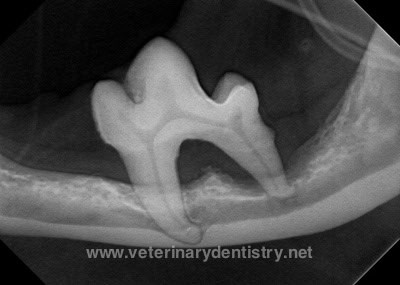
Veterinary dental radiograph showing molar pathology and bone changes in veterinary dentistry diagnosis
Radiograph demonstrating severe bone loss surrounding both roots of the right mandibular left first molar in a dog

Question:

An 11-year-old small mixed breed dog presents for a professional dental cleaning. Your radiographs show severe bone loss.

What is your approach from here?
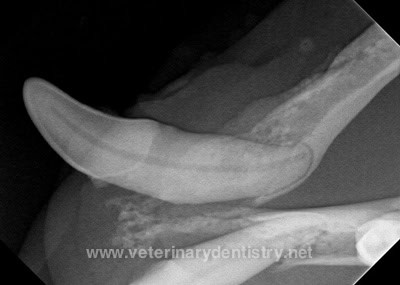
Veterinary dental radiographs reveal severe bone loss adjacent to the left mandibular canine tooth, particularly significant on the mesial aspect

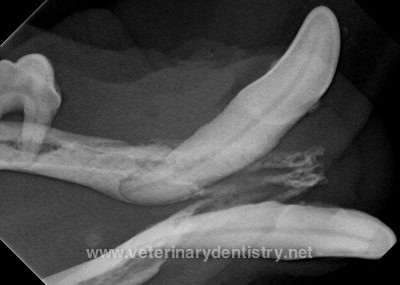
Veterinary dental radiographs of the right mandibular canine in a dog with severe periodontal disease

Answer:

Based upon the severity of the bone loss, referral to a board certified veterinary dentist may/should be considered for the patient depending on your surgical skill and comfort level with delicate surgical extractions.
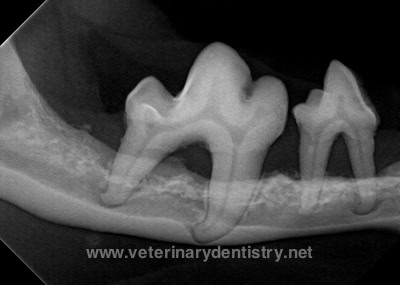

Veterinary dental radiograph demonstrating stage four periodontal disease in the right mandibular fourth premolar and first molar in a dog. Note the dilaceration of all of the group tips making extraction, particularly challenging.

Question:

What should you discuss with the pet guardian regarding treatment in your hospital or referral?

Answer:

The chance of mandibular fracture is possible in at least 4 separate locations.  Doing nothing will only allow progression of the infection and bone destruction leading to likely mandibular fracture secondary to minor trauma or day to day activities, including mastication.  Even if referred to  a specialist, mandibular fracture is possible. However, if  a mandibular fracture occurs during extraction, repair can be immediately performed by the specialist.
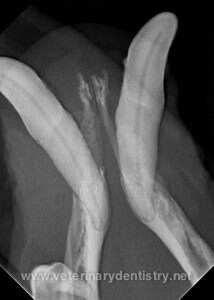
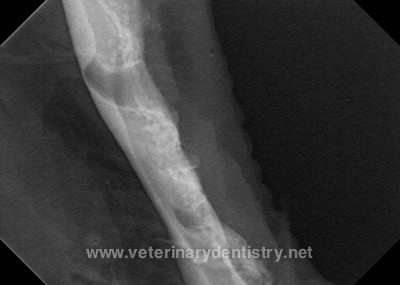
Radiographic view showing both mandibular canines experiencing profound bone loss associated with stage four periodontal disease. Advanced veterinary dental extraction techniques are required to prevent mandibular fracture.


Veterinary dental radiograph demonstrating postop image of the right mandible in a dog with severe periodontal disease.

Question:

What if the client is not interested in the referral and the procedures pushes your surgical skills and comfort level?
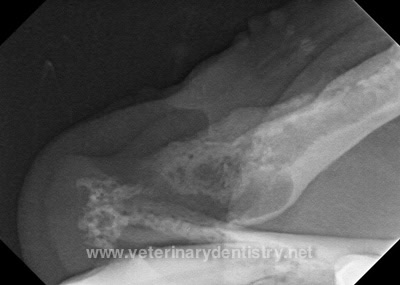
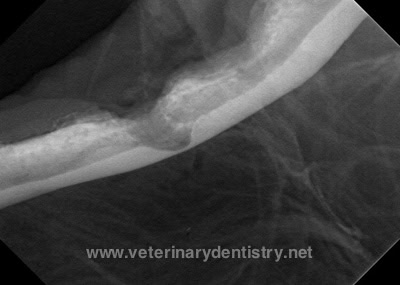
Post-op radiograph of the left mandibular canine extraction site in a dog with profound generalized periodontal disease

Post extraction radiograph of the left mandible bone extraction of the first molar in a dog with advanced periodontal bone loss.

Answer:

The responsibility is first to “do no harm.”

Fortunately careful open surgical extraction technique eliminated fracture in this case.  The alveoli were debrided of granulation tissue and the remaining bone carefully contoured to remove rough edges.  A blood clot or bone graft should occupy what is left of the alveolus prior to primary closure of the surgical flap.  It should be noted that a bone graft provides no assurance of short term fracture as there is no additional inherent strength. New bone is required for increased strength.

Veterinary Dental On-Demand Online Courses

The Canine Dentistry Online Course
Comprehensive Feline Dentistry Online Course
Simple and Surgical Extractions in the Dog and Cat Online Course
Comprehensive Veterinary Dental Radiongraphic Interpretation Course
Veterinary Dentistry for the Veterinary Technician Online Course

FIND OUT WHY

OUR FRIENDS ARE SMILING

Dr. Erin V. Abarahams's Review for Dr. Brett Beckman's Veterinary Dental Webinars On Demand Online Dentistry Courses
Dr. Greg Wolfus's Review for Dr. Brett Beckman's Veterinary Dental Webinars On Demand Online Dentistry Courses
Dr. Farshid Kiaei's Review for Dr. Brett Beckman's Veterinary Dental Webinars On Demand Online Dentistry Courses
Dr. Kayla Simpson's Review for Dr. Brett Beckman's Veterinary Dental Webinars On Demand Online Dentistry Courses
 
 
More Vet Reviews More Tech Reviews